
Discussion Paper on Bridging Trust Deficit Enabling Ease of Running a Business in India

Capacity Building on Infrastructure Regulatory Issues (I and II edition)
Discussion Paper on Analysing effect of regulation of Over-the-Top (OTT) Services on consumer interest and comparing international perspectives
Impact of Barriers on Cross-Border Data Flow on Ease of Doing Digital Business in India
Walking the Talk of Covid through Investment Policies
The paper looks into the historical shift from mid-2021 in foreign direct investment (FDI) and other investment policies in the host countries, considering the similarities and differences in light of COVID19. It argues that global adverse events lead to convergence in the investment policy response of the countries, for
Impact of Unnecessary Compliances Ease of Doing Digital Business in India
The Discussion Paper distinguishes between necessary and unnecessary compliances by using elements of the regulatory guillotine framework and expands upon the core principles of ‘legality’, ‘necessity’, and ‘business friendliness’. Further, the paper renews the discussion on unnecessary compliances, costs associated, and their impact on digital businesses. It concludes with
The Environmental, Social, and Governance (ESG) Model of Workers’ Welfare
The ESG-centric approach combined with socially responsible investing is creating a paradigm shift for investors’ interest across the globe. CUTS International, through this Discussion Paper under ‘Institutionalising good and better jobs in India’ (GrowJobs-II), is building a narrative towards investors integrating social considerations into their strategic investments. The
Impact of Inadequate Digital Infrastructure on Ease of Doing Digital Business in India
The Discussion Paper unpacks the digitalinfrastructural constraints that hinder the digital economy’s growth and the digital business ecosystem. In its analysis, the paper goes beyond ‘connecting the unconnected’ framework, in the spirit that connectivity doesnot necessarily translate into positionality to use services and business opportunities
Prospects of Pumped Storage in Energy Transition
With the world gradually transitioning to clean energy, several challenging questions emerge, such as – whether or not we have modern technologies at our disposal. If indigenisation of such technologies can reduce cost, what are the alternatives, and who bears the brunt of this transition? Whether this transition to
Facilitating a Transition Away from Coal in India
The Indian government is currently trying to facilitate a shift from a conventional to an alternative energy base. However, while reducing our reliance on fossil fuels like coal, several challenging questions emerge: Who is bearing the brunt of this process that will inevitably induce structural shifts in the Indian economy? While
Discussion Paper on Impact of Regulatory Uncertainty on Ease of Doing Digital Business in India
Regulating the digital economy becomes tougher due to its cross-cutting nature, which causes regulatory overlaps. Further, the difficulty intensifies due to the lack of regulatory procedures. The Discussion Paper highlights several reasons that cause regulatory uncertainty for digital businesses, including lack of regulatory framework, excessive delay in enacting regulations,
Discussion Paper on Impact of Criminalising Provisions on Ease of Doing Digital Business in India
In furtherance of its efforts in promoting a digital economy for consumer welfare, CUTS has undertaken a study titled ‘Ease of doing Digital Business in India.’ CUTS is releasing a discussion paper series, and the first paper in this series is titled ‘Impact of Criminalising
Artificial Intelligence:Implications for Consumers
The advance of Artificial Intelligence (AI) technologies has brought with it many benefits for consumers, in the form of new or improved products and services, ëmore intelligentí and faster delivery, reduced search and transaction costs, and increased safety. This Dicussion Paper seeks to analyse the benefits and costs of

Future of Coal in India
Coal, being an important source of energy generation, remains preferable to India for fueling its economic growth. Approximately, 70 percent of Indiaís electricity generation is dependent on coal. The coal sector has several structural issues and regulatory challenges. The sector is facing numerous issues, such as lukewarm demand,
Status of Implementation of Real Estate (Regulation and Development) Act, 2016 in Select States of India
Real Estate (Development and Regulation) Act, 2016 (RERA), a pro-consumer legislation aims to protect the interest of consumers by ensuring accountability, transparency and establishing an adjudicating mechanism for speedy redressal of disputes. The paper highlights the progress made by select four States and a Union Territory with respect
Is there a Bright Future Ahead for India’s Pharmaceutical Market?
This paper analyses the underlying discourses in Indiaís on-going public policy reforms and debates in the pharmaceutical sector. It identifies the dominant discourse and discusses its impact on consumers in the context of Indiaís contemporary epidemiological and demographic transition, political agenda, economic ambitions, market dynamics and legal framework.
Beyond a Band-Aid Approach for Electricity Distribution Reforms in India Political Economy Analysis and its Implications
This Discussion Paper analyses issues faced by the distribution sector and evaluates the subsequent reforms vis-a-vis their effectiveness in dealing with the issues. It explains the prereform scenario of the power distribution sector in order to trace the evolution of problems faced by the sector. The paper
Facilitating Interoperability in Digital Finance Services in India
Interoperability is usually understood as ability of different networks/systems/tools to communicate with each other, exchange and use/process data. The term has gained prominence with advent of digital finance in emerging economies. India has witnessing tectonic shifts with respect to regulation and market practices on interoperability. This Discussion Paper
Privatisation in Ghana
The goal of this Discussion Paper is to empirically analyse the case of privatisation in Ghana to determine what factors led to successes and what policies led to failures. It outlines the establishment of state-owned firms in Ghana, motivation and process of privatisation with a particular emphasis on
Balancing State, Utility and Social Needs in Agricultural Electricity Supply The case for a holistic approach to reform
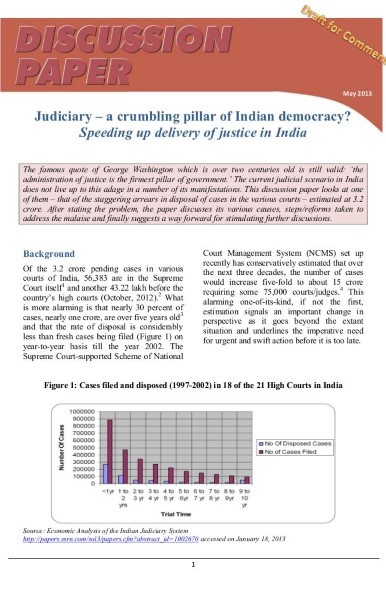
Judiciary – a crumbling pillar of Indian democracy?- Speeding up delivery of justice in India
The famous quote of George Washington which is over two centuries old is still valid: ëthe administration of justice is the firmest pillar of government.í The current judicial scenario in India does not live up to this adage in a number of its manifestations. This Discussion Paper looks at one of them
Filters