Empowering Consumers for Sustainable Development: Exploring the Link Between UNGCP and SDGs
Rethinking Special and Differential Treatment in the WTO
Debates on Special and Differential Treatment (S&DT) at the WTO seem to have largely shifted from the effectiveness of provisions to the eligibility of WTO members for availing S&DT. Today, there is no consensus among WTO members on fundamental aspects of S&DT. There is no real way to measure whether
Understanding Logistics Ecosystem in Bihar and its Scope for Improvement
Role of Northeast Indian States in Shaping India’s Logistics Performance
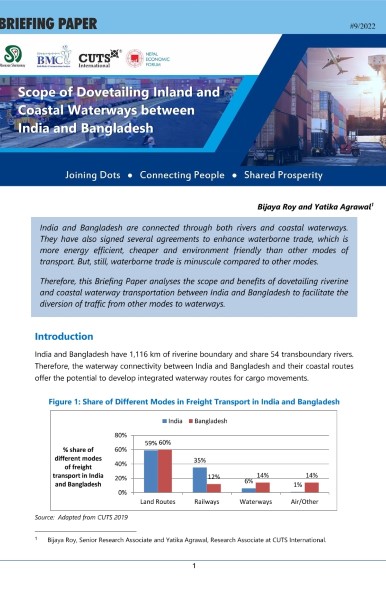
Scope of Dovetailing Inland and Coastal Waterways between India and Bangladesh
India and Bangladesh are connected through both rivers and coastal waterways. They have also signed several agreements to enhance waterborne trade, which is more energy efficient, cheaper and environment friendly than other modes of transport. But, still, waterborne trade is minuscule compared to other modes. This Briefing Paper attempts to analyse
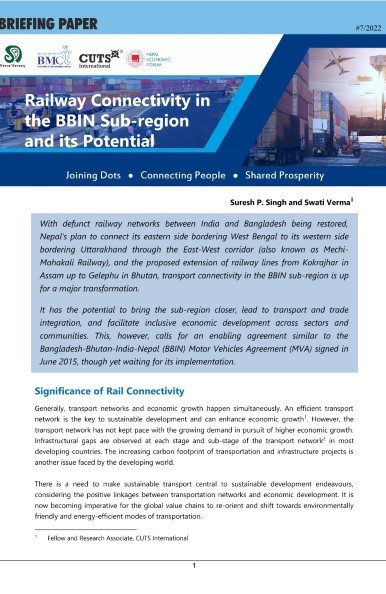
Railway Connectivity in the BBIN Sub-region and its Potential
With defunct railway networks between India and Bangladesh being restored, Nepal’s plan to connect its eastern side bordering West Bengal to its western side bordering Uttarakhand through the East-West corridor (also known as Mechi-Mahakali Railway), and the proposed extension of railway lines from Kokrajhar in Assam up to Gelephu in Bhutan,
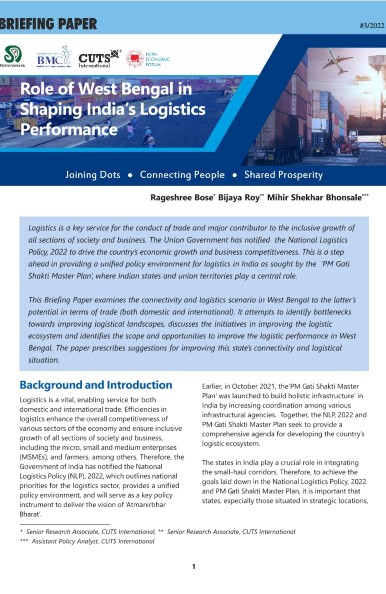
Role of West Bengal in Shaping India’s Logistics Performance
Logistics is a key service for the conduct of trade and a major contributor to the inclusive growth of all sections of society and business. The Union Government has framed the National Logistics Policy, 2019 to drive the country’s economic growth and business competitiveness. A step ahead in providing a
Border Area Prosperity through Improved Connectivity: The Case of Northeast India
This Briefing Paper aims to understand the linkages between connectivity and prosperity in the Northeast Border Region of India. Connectivity aids the region’s development and paves the way for the improvement of social infrastructure. The Paper analyses the cross-border infrastructure projects and Government of India’s schemes, such as Border Area Development Programme,
Transform Transport Corridors into Economic Corridors: Towards Inclusive Growth & Trade in the BBIN Sub-Region
Even if tariffs are reduced to zero, along with a reduction in the sensitive list of products, non-tariff and para-tariff barriers, trade in the BBIN sub-region may not achieve its optimum level; unless there is regional agreement towards trade facilitation encompassing transport connectivity, efficient transport, transit and trade logistics; minimisation of
Transforming Urban Governance in Rajasthan – Through Capacity Building and Better Financial Management
Facilitating Cross Border Paperless Trade: Benefits of Cooperation for BBIN Countries
Strengthening Railway Networks in Northeast India: A Key Driver to Deepen Sub-regional Connectivity and Trade
Cybersecurity challenges for Indian MSMEs
The advancement in digital technologies has transformed businesses and processes across the globe. More importantly, the shift towards adopting digital technologies is prominent in developing countries, such as India. The digital economy contributes about 14 percent to India’s gross domestic product (GDP) and is expected to grow up
Border Haats on Bangladesh-Myanmar Border Opportunities and Challenges
Aviation Logistics in the BBIN Sub-region: Pathways for greater resilience
Kaladan Multi- Modal Transit Transport Project: Navigating Myanmar’s Ethnic Conundrum
Story of Change- Elimination of Trans Fatty Acids by Hindustan Unilever Limited
Moving Towards Trans Fat Free Bakery Products – A Case Study Of Kerala
Border Haats as Centres for Exchange of Agricultural Inputs, Ideas and Practices
Border Haat as a Means to Promote Trade and Cross-border Value Chains Between Northeastern States of India and Bangladesh
Can Border Haats Become Centres for Cultural Exchange, Tourism and People-to-People Connectivity
Food Labelling Regulations in India – Need of Strong Front of Package Labels
Discussion Paper-E-Commerce in the Context of Trade, Consumer Protection and Competition in India
Significance of grid connected rooftop solar photo voltaic in Kolkata and other urban spaces of West Bengal

Mobile Internet Services in India: Quality of service
This study attempts to bring together secondary and primary data to sift issues and provide evidence-based policy recommendations towards better enforcement of Quality of Service (QoS) for mobile internet services. It focussed on collecting measurements from several rural and urban areas on the QoS consumers receive from various 2G/3G
Enabling Effective Competition in Mobile Money Market 2015
This Briefing Paper provides an overview of the state of competition in different mobile money markets and points to the secular trend of low-level of competition across jurisdictions despite different growth trajectories of mobile money markets. It goes on to discuss the policy and practice distortions to competition
Competition and Regulatory Issues in the Railway Sector in India 2014
The Indian railways form an integral part of the transport sector and its growth, efficiency and competitiveness are essential for the rapid growth of the sector vis-‡-vis the economy. However, recent statistics have reflected a negative growth of the monopolistic railway sector. This Briefing Paper aims to provide an overall understanding of the
Geneva Consensus for Trade Multilateralism A Relook at the Eighth Millennium Development Goal – Global Partnership for Development

Ensuring Access to Rare Earths Are WTO Disciplines on Export Restrictions Enough?
Trade and Exchange Rates Effects of Exchange Rate Misalignments on Tariffs

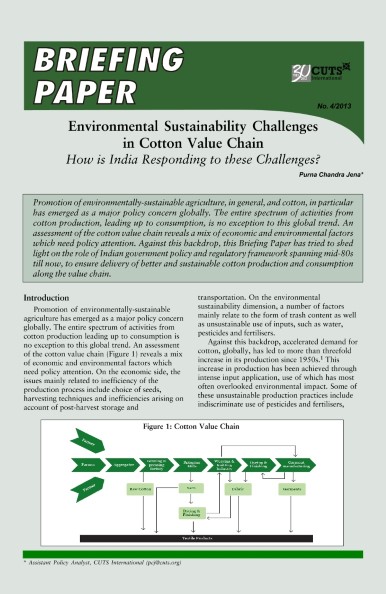
Environmental Sustainability Challenges in Cotton Value Chain How is India Responding to these Challenges?
Returns from Investment in Government-Citizens Interface An Evaluation
Harmonising Regulatory Conflicts 2013
Competition agencies and sector regulators have a common objective of promoting healthier economic governance through pro-competitive regulation. The sector regulators look into the issues ex-ante, whereas the competition authority deals with ex-post issues. Despite a common goal, these bodies have different legislative mandates and perspectives for competition issues, and ambiguities. Thus, securing a clear delineation
Essential Facilities Doctrine 2013
This Briefing Paper states that notwithstanding relative successes and failures of such interventions, as the Indian economy grows and matures it is inevitable that for wider and more complete encouragement of competition, the essential facilities doctrine (EFD) will need to flow in from the Competition Commission and competition law which is adequately structured to

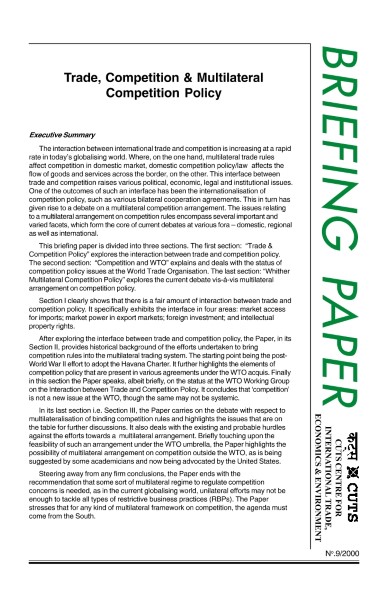
International Trade and Competition – Siamese Twins: Need for a Multilateral Framework on Competition? 2013
This Briefing Paper studies arguments for and against multilateral competition framework with a focus on agriculture and commodity markets sector and discovers that chief losers from absence of a multilateral competition framework are consumers around the world. It further attempts to suggest a workable way forward by taking into account concerns of
Effect of Direct Transfer of Cash on Competition in Market 2013
This Briefing Paper throws light upon specific developmental objectives that could be achieved through proper implementation of the scheme. The paper focuses upon how direct transfer of cash would help establishing developed and competitive market, especially in rural India. It also deals with factors that could lead to a more conducive environment for infusing competition in
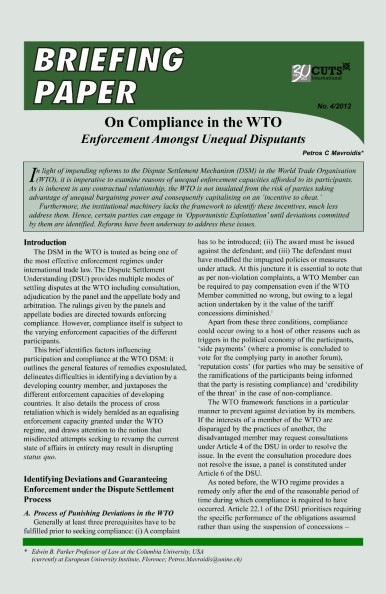

Economic Effects of Third Party PTAs on India – Analyses of Some Selected Cases
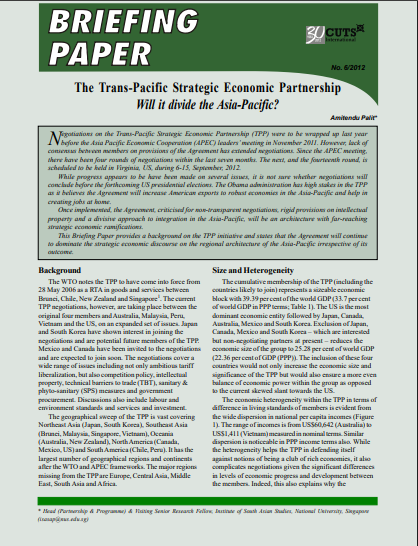
The Trans-Pacific Strategic Economic Partnership – Will it divide the Asia-Pacific?
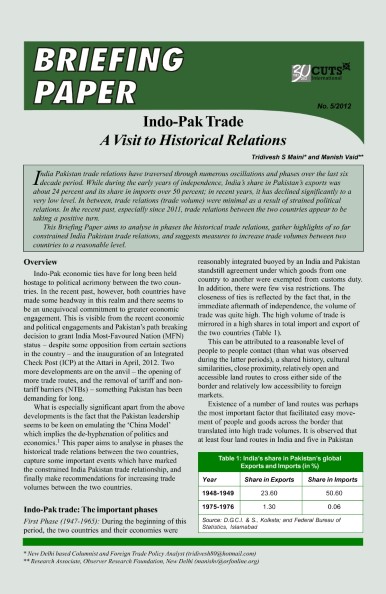

Trade and Environment Linkages Empirical Evidences from Textiles & Clothing Sector in India

Indian Textiles & Clothing Sector Environmental Standards and Consumer Knowledge in the EU

Civil Society’s Participation in Trade Policy Making: Case of CUTS International
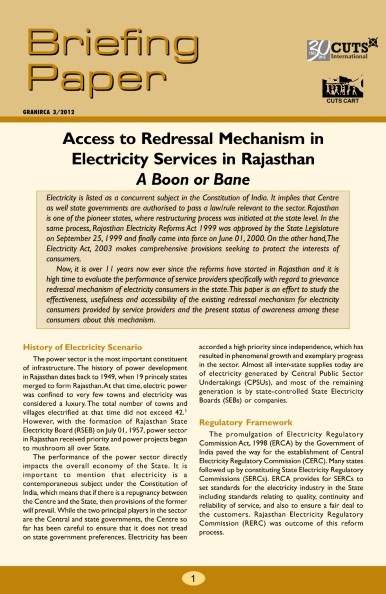
Access to Redressal Mechanism in Electricity Services in Rajasthan A Boon or Bane
South Asian Countries in the Doha Development Round Need for Better Coordination
Promoting Competition Reforms for Development How to Proceed in West Africa? 2011

Collusive Behaviour in Healthcare and Impact on Consumers Evidence from Assam 2011
Collusive Behaviour in Healthcare and Impact on Consumers Evidence from Chhattisgarh 2011
Multinational Corporations in Developing Countries Are Competition Concerns Ignored? 2011
Food Inflation in India Encourage Competition for a Long-term Solution 2011
New Insights into the Impact of the Doha Round on the Indian Economy Results of a Recent CUTS Study
Reforming and Strengthening the WTO: Some Reflections and Suggestions
Reforming the World Trade Organisation: Developing Countries in the Doha Round
India ASEAN FTA – A Move towards Multilateral Free Trade Agreements? (1/2010)
Re-Thinking Global Economic Governance: Promoting Development and Managing Crises
Facilitating Sustainable Development in the Developing World Ensuring that Economic Growth is Inclusive and Environmentally Sustainable
Improving the Service Delivery by Measuring Rate of Absenteeism and Initiating Community Monitoring in 30 Health Centres in Tonk District of Rajasthan, India
Consumer Protection in the Financial Sector: Challenges and the Way Forward
Marche à suivre pour la bonne administration de la concurrence en Afrique orientale et australe 2010
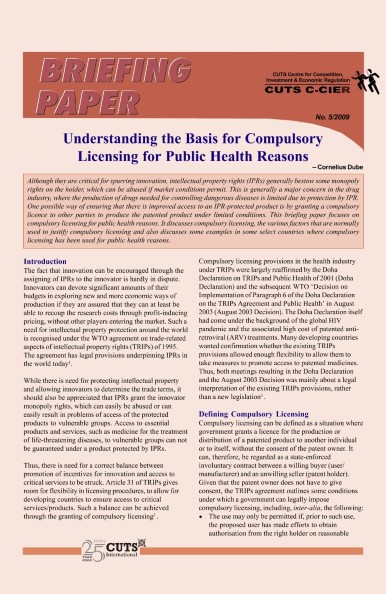
Understanding the Basis for Compulsory Licensing for Public Health Reasons 2009
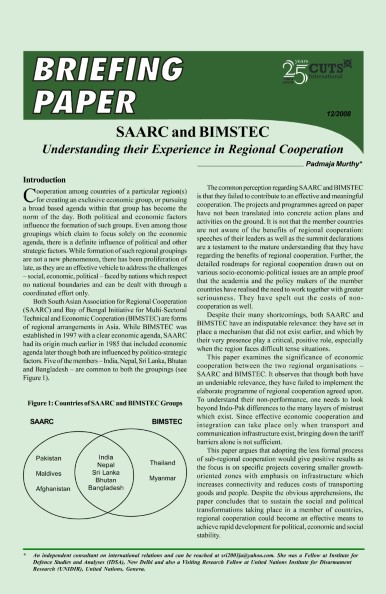
SAARC and BIMSTEC – Understanding their Experience in Regional Cooperation

Factors Affecting Competition in the Agricultural Produce Markets in India 2008
Dealing With Anti-Competitive Practices in the Indian Pharmaceuticals and the Health Delivery Sector 2008
Competition Policy and Economic Growth –Is There a Causal Factor? ( In English,In French) 2008
Taking the Right Steps: Competition Administration in Eastern & Southern Africa 2008
Extraterritorial Application of Competition Laws in the US and the European Union 2006

Competition Scenario in the Telecommunication Sector in Cambodia, Laos and Vietnam 2006

The Telmex Dispute at the WTO: Competition Makes a Backdoor Entry 2006
Strengthening Inter-State Connectivity in India’s Bordering States for Trade and Inclusive Development

National Champions National Interests vs. Competition: Where to Strike the Balance? 2003

The Role of International Cooperation in Building an Effective Competition Regime 2003
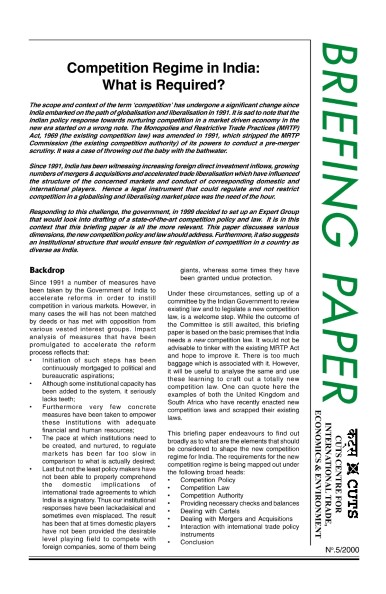
Contours of a National Competition Policy: A Development Perspective 2001
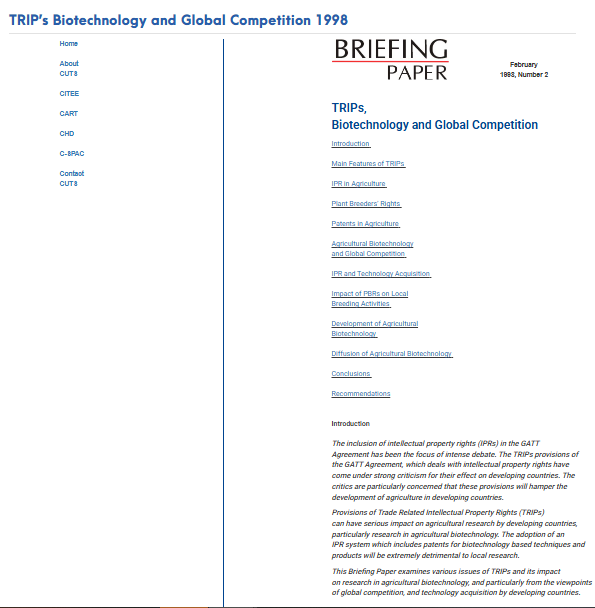
The functioning of Patent Monopoly Rights in Developing Countries: In Whose Interest 2000
Filters