
Competition Enforcement for Business Collaborations during COVID-192020
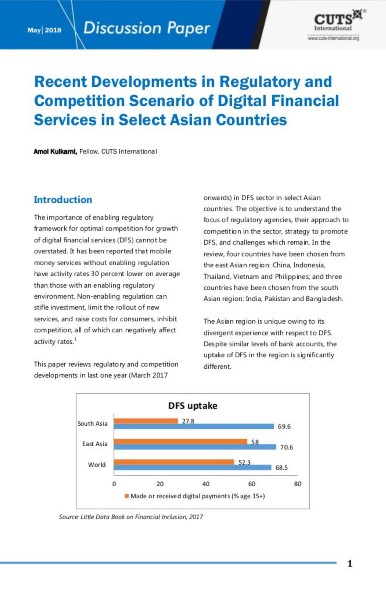
The COVID-19 pandemic and its associated restrictions have necessitated a rise in collaborations among businesses due to various demand and supply shocks in the economy. This has led competition authorities worldwide to reconsider competition law enforcement, thus ensuring the supply and distribution of essential goods and services. This Discussion
(Not) the way to promote digital payments2018
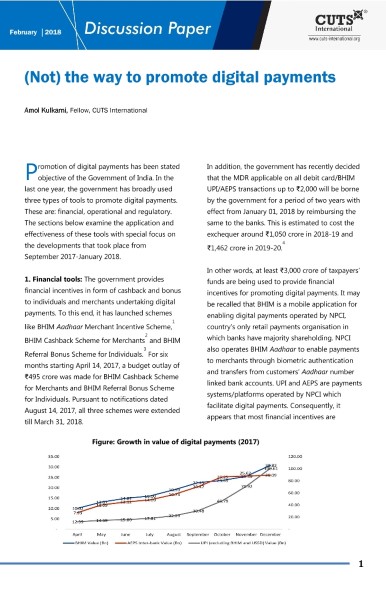
Promotion of digital payments has been stated objective of the Government of India. In the last one year, the government has broadly used three types of tools to promote digital payments. These are: financial, operational and regulatory. The sections below examine the application and effectiveness of
Designing Effective Leniency Programme for India: Need of the Hour2015
The OECD Recommendation of the Council Concerning Effective Action against Hard Core Cartels adopted on March 25, 1998 defined ‘hard-core cartel’ as“…an anticompetitive agreement, anticompetitive concerted practice, or anticompetitive arrangement by competitors to fix prices, make rigged bids (collusive tenders), establish output restrictions or quotas,
Gujarat Inter-city Transport Regulatory Authority2015
The aim of the paper is to, therefore, highlight the possible approaches that the DoT, Government of Gujarat could consider for the development of an inter-city public transport regulator in Gujarat (Gujarat Inter-city Transport Regulatory Authority).
Assisting Transition to Better Bus Transport Regulation in Select Countries2015
This purpose of this paper is to act as a reference for policymakers and implementers to better understand the good practices in urban bus transport reforms. The need for developing this paper was felt in the Diagnostic Phase (Phase I) of the project under which
Cost of Monopoly in Bus Transport Case of Gujarat2015
This paper builds upon the CREW Project’s findings in relation to the intercity bus transport system in Gujarat, India. The existing project analysed the interstate bus transport system in Gujarat with an emphasis on areas where the introduction of competition could potentially increase performance outcomes.
Dimensions of Competition Policy and Law in Emerging Economies2011
The paper identifies inadequate awareness and lack of competition culture as stumbling blocks to the successful adoption of competition policy and law by emerging economies. The paper also clarifies implementation modalities, such as the shaping of the content of competition policy and law and the
Informal Sector and Competition: A Comprehensive Agenda for Research and Action2009
The paper recommends that the decision to formalise the informal sector should be based on a cost-benefit analysis. It goes on to elaborate various methods of formalisation: reduction in the number of procedures/clearances involved or time involved in registration of firms in the formal sector,

Multilateral Competition Framework: In Need of a Fresh Approach2005
The paper identifies the relevant competition problems and suggests a way forward for international cooperation to deal with them. It suggests that a brand new organization, dedicated solely to competition issues under the auspices of the UN, will be most suitable.
Filters